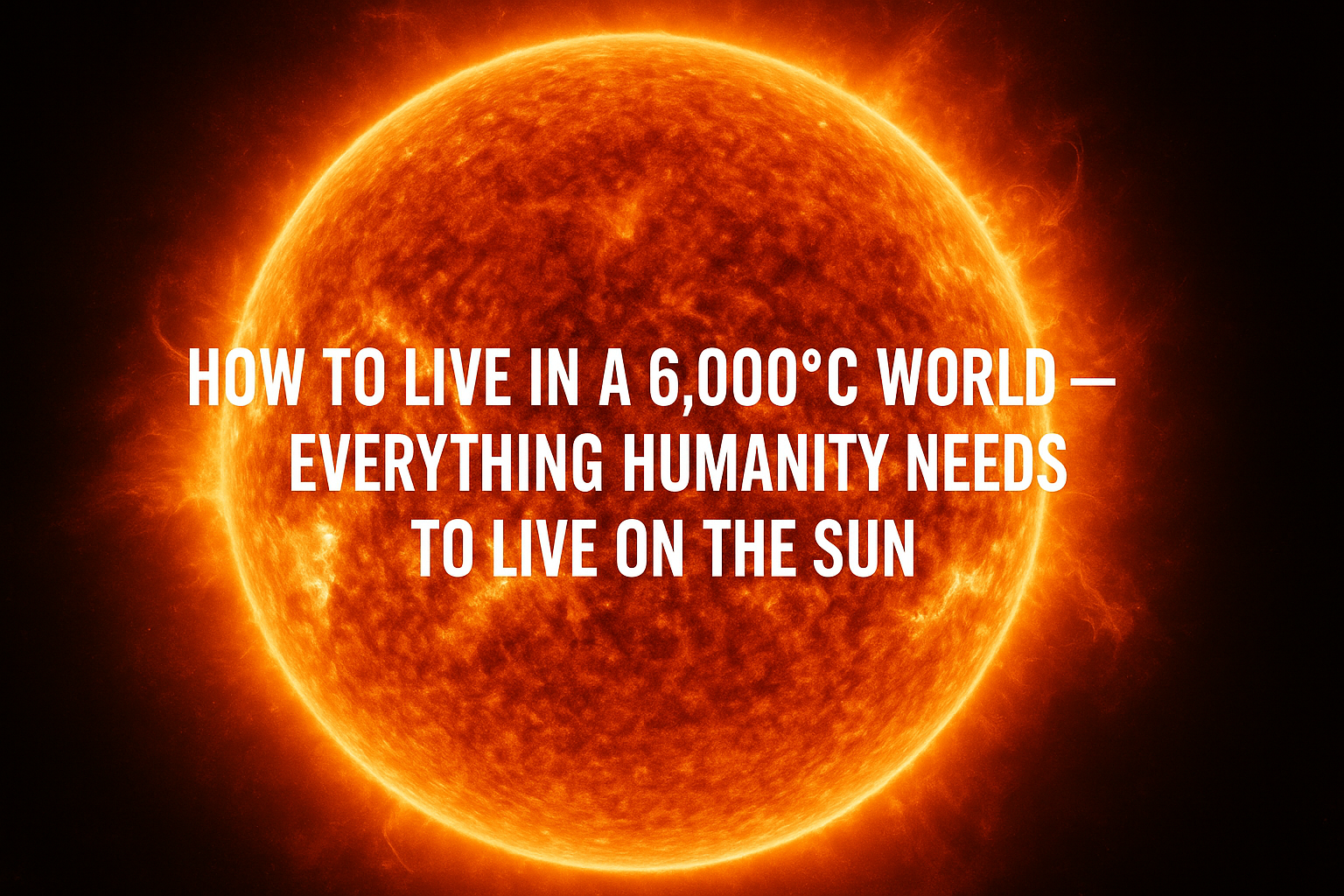
- 🌞 Introduction | What Would Happen If Humanity Seriously Tried to Live on the Sun?
- Chapter 1|What Kind of Place Is the Sun?
- Chapter 2|If We Had to Live There—Scientific and SF-Based Solutions
- Chapter 3|A Day Living on a Solar-Orbit Floating Colony
- Chapter 4|Real Solar Research Happening Today
- Chapter 5|What We Can Do Today for Humanity’s Solar Future
- Conclusion|Solar Migration Isn’t “Impossible”—It’s a Question for Future Technology
🌞 Introduction | What Would Happen If Humanity Seriously Tried to Live on the Sun?
When you hear the phrase “living on the Sun”, most people immediately think:
“Impossible.”
“It would burn me instantly.”
“You can’t live on a star.”
…And that reaction is absolutely correct.
With a surface temperature of 6,000°C and a core that reaches 15 million°C, the Sun is essentially a massive nuclear fusion reactor. Under normal circumstances, no one can get close—let alone live anywhere near it.
However, in recent years, advances in solar research and space technology have encouraged scientists, futurists, and SF thinkers to ask:
“What if humanity reached a level of technology far beyond our current capabilities?”
“What if we seriously imagined living near the Sun through future science and engineering?”
Of course, this is not something that will become reality next year—or even within our lifetime.
But by combining scientific facts and SF-like imagination, it is possible to paint a surprisingly vivid picture of the future.
In this guide, we will explore:
🔥 Easy-to-understand basics about the Sun
🔥 Why humans cannot live there—explained through science
🔥 What kinds of future technologies could make “Sun-adjacent living” possible
🔥 What a day on a solar-orbit floating colony might look like
🔥 Current real-world solar research conducted by agencies like NASA and ESA
🔥 And finally, what we can do today to prepare for humanity’s long-term future
Let’s begin our journey toward understanding how humanity might one day approach the impossible—
living near the Sun.
Chapter 1|What Kind of Place Is the Sun?
The Sun is a star, located about 150 million kilometers from Earth.
It appears brighter and larger than other stars simply because of its proximity.
But its internal environment is far harsher—even beyond what most people imagine.
Before thinking about “living near the Sun,” we first need to understand the basics.
■ 6,000°C on the surface, 15 million°C at the core
At the Sun’s center, nuclear fusion occurs—where hydrogen atoms merge to form helium, releasing enormous amounts of energy.
-
Core temperature: 15,000,000°C
-
Surface (photosphere): 6,000°C
-
Corona (outer atmosphere): 2–3 million°C
In other words, the Sun is not “burning.”
It is a gigantic nuclear fusion reactor, constantly releasing energy.
■ Gravity 28 times stronger than Earth’s
The Sun has 330,000 times the mass of Earth.
A person weighing 60 kg on Earth would feel like:
→ 1,680 kg on the Sun.
Walking, running, or even standing would be physically impossible.
■ No solid ground — The Sun is made of gas
The Sun consists mainly of hydrogen and helium.
There is no solid surface. The deeper you go:
-
Temperature increases
-
Pressure skyrockets
-
Matter becomes plasma (ionized, ultra-hot gas)
Any structure placed inside would be instantly destroyed.
■ Solar wind — high-speed streams of plasma
The Sun constantly emits solar wind, which shoots out charged particles at:
400–800 km/s.
Entering this stream unprotected would instantly damage living cells and electronics.
■ Solar flares — massive explosions
The Sun occasionally erupts with explosions called solar flares, releasing enough energy to disrupt:
-
Communication systems
-
GPS
-
Satellites
-
Electrical grids on Earth
Even today, solar flares can cause global-scale disturbances.
In short:
Even getting close to the Sun is extremely difficult—long before considering living there.
Chapter 2|If We Had to Live There—Scientific and SF-Based Solutions
Given all of these harsh conditions, what would it take to live near the Sun?
Scientifically, it is impossible with current technology.
But by imagining the future—100, 500, or even 1,000 years from now—we can explore potential pathways.
■ Problem 1: Surviving 6,000°C Heat
The Sun’s heat would melt any metal instantly.
→ Future Concept: Absolute Thermal Shield
While not currently possible, SF-level technology proposes:
-
Super-reflective materials that reflect 90%+ of sunlight
-
Plasma-based “heat walls”
-
Devices that convert heat directly into energy to keep structures cool
With such advancements, a base could theoretically operate near the Sun.
■ Problem 2: Extreme gravity
Sun-level gravity would crush all structures and life.
→ Solution: Live in solar orbit, not on the Sun
Instead of living “on” the Sun, humans would live:
☀ In a giant solar-orbit colony
(orbiting at a safe distance)
This avoids extreme gravity while maintaining proximity.
■ Problem 3: Protection from solar wind
Solar wind is a constant flood of high-speed charged particles.
→ Solution: Artificial magnetic shields
Just like Earth’s magnetic field protects us, future colonies could generate:
-
Large-scale magnetic bubbles
-
Electrically controlled magnetospheres
to deflect harmful particles.
■ Problem 4: Overwhelming brightness
Near the Sun, light can be tens of thousands of times brighter than on Earth.
→ Solution: Multi-layer light-control domes
Using:
-
Polarization filters
-
Radiation-resistant glass
-
Multi-layer optical shields
colonies could create comfortable, Earth-like lighting.
■ Problem 5: No place to build anything
The Sun has no solid surface.
→ Solution: Floating solar cities (solar-floating colonies)
Future concepts include:
-
Cities floating on light pressure
-
Magnetically levitated platforms
-
Structures propelled by solar wind
All powered by the Sun’s abundant energy.
Chapter 3|A Day Living on a Solar-Orbit Floating Colony
Now, let’s imagine the lifestyle.
Not on the Sun’s surface, but in a giant colony orbiting very close to the Sun.
🌞 Morning — Waking up in a golden world
The colony’s light-control dome softens the harsh sunlight, filling your room with warm, gentle golden light.
Outside:
-
It’s always bright
-
No clouds
-
The Sun appears as a giant glowing wall
It’s a beautiful but surreal sight.
🌞 Afternoon — Working in solar research and energy management
The main jobs would include:
-
Solar observation
-
Energy collection and transmission
-
Magnetosphere maintenance
Colony residents help oversee the flow of solar energy sent directly to Earth.
🌞 Evening — A manufactured sunset
The Sun does not set.
But the colony dome creates artificial sunset lighting:
-
Gold → Orange → Deep red
A breathtaking transition that rivals Earth’s true sunsets.
🌞 Night — A brief moment of darkness
When the colony moves to a point where the Sun is blocked,
a short window of darkness appears.
This “night” lasts only minutes but is deeply peaceful—
a precious moment in a world of eternal sunlight.
Chapter 4|Real Solar Research Happening Today
Even though humans can’t approach the Sun, research is rapidly advancing.
■ NASA’s Parker Solar Probe
The first craft to fly closest to the Sun:
-
Approached within 6.9 million km
-
Reached speeds over 700,000 km/h
-
Studied the corona directly
A revolutionary step in solar exploration.
■ ESA’s Solar Orbiter
This spacecraft studies the Sun’s north and south poles to understand magnetic activity—
crucial for predicting solar flares and future protection technologies.
■ Future: Giant Space Solar Power Stations
Many nations are now researching:
☀ Collecting solar energy in space and sending it to Earth
via:
-
Microwaves
-
Lasers
This concept is a major step toward utilizing solar power on a civilization-wide scale.
Chapter 5|What We Can Do Today for Humanity’s Solar Future
Living on the Sun is impossible.
But living near it, or harnessing its power directly, may become essential for human survival in the far future.
Today, we can:
-
Stay curious about space
-
Learn about energy and scientific technology
-
Expand our imagination for humanity’s future
Even reading this article means you’ve taken a small step toward that future.
Conclusion|Solar Migration Isn’t “Impossible”—It’s a Question for Future Technology
The Sun is overwhelmingly hostile:
-
6,000°C surface
-
Gigantic gravity
-
Solar wind
-
Massive flares
No current technology could enable human habitation nearby.
However—
with future advances, living in solar orbit or building floating colonies might one day be possible.
But the most important thing is not whether it becomes reality.
It is the question:
🌞 “If we could live near the Sun… how would we do it?”
This simple curiosity is what opens the door to new technologies and new futures.
Would you like to see a world where shining solar colonies drift around the Sun?
If you would, then the future might be waiting for someone like you to help create it.
Comment