- Introduction|The Day Humans Live on Mars Is Getting Closer
- Chapter 1|What Kind of Place Is Mars?
- Chapter 2|How Could We Live There? Challenges and Solutions
- Chapter 3|What Would a Day on Mars Look Like?
- Chapter 4|How Close Are We Technologically?
- Chapter 5|What Can We Do Now for a Future on Mars?
- Summary|Mars Habitation Is Not “Right Around the Corner,” but the Path Ahead Is Visible
Introduction|The Day Humans Live on Mars Is Getting Closer
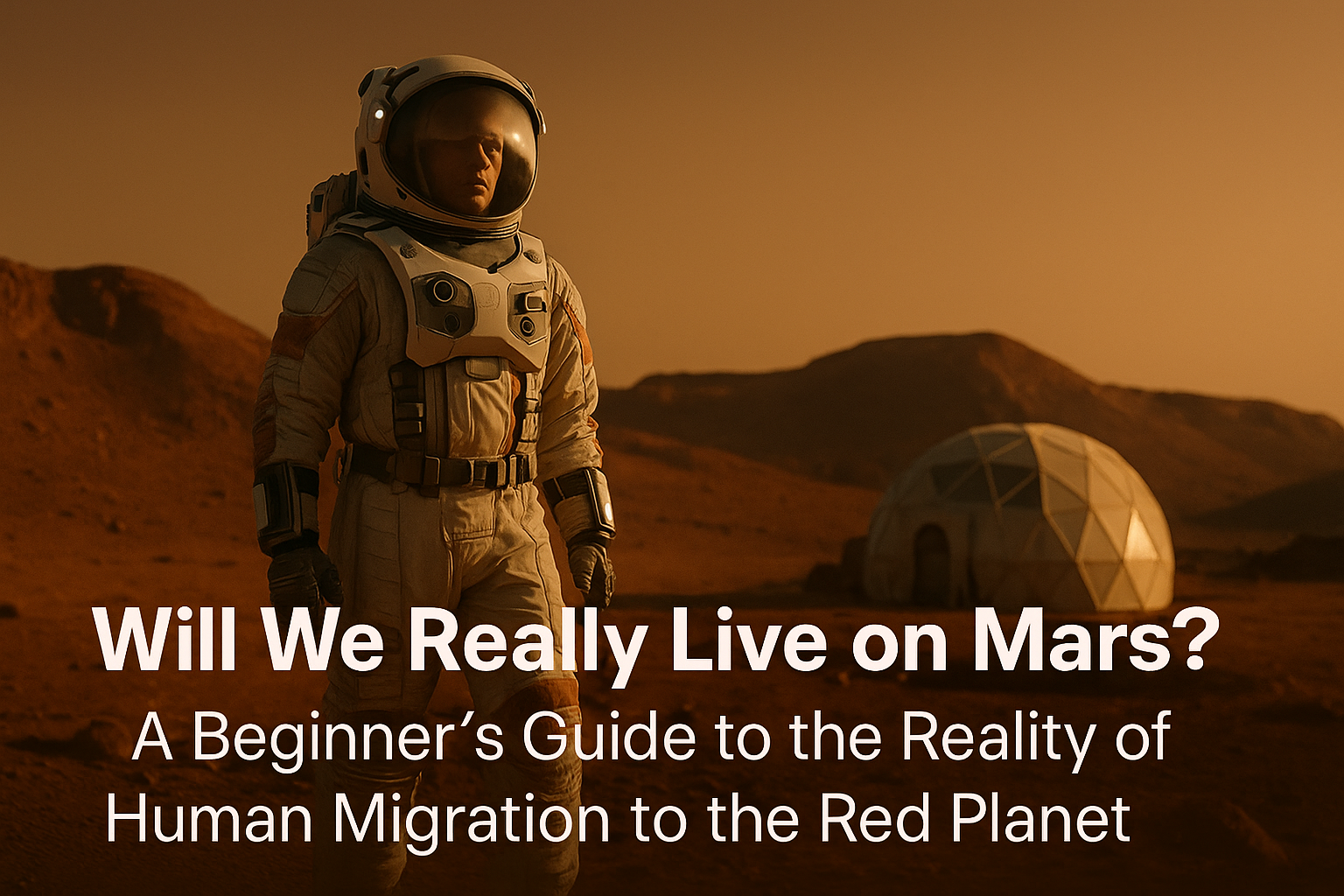
When you hear the phrase “living on Mars,” many people may think, “That’s still far in the future,” or “That’s just science fiction.” It’s true that we can’t relocate there right away. However, in the past few decades, space development technology has advanced rapidly, and Mars habitation is gradually shifting from a “dream-like fantasy” to a “realistic future option.”
For example, NASA is promoting Mars exploration from the perspectives of “the possibility of life,” “investigating past and present environments,” and “future human habitability,” and has already sent various robotic probes. Considering these efforts, some experts suggest that “we may be able to live on Mars in the 2030s or 2040s.”
So in this guide, we will walk you through essential points such as “What kind of place is Mars?”, “What do we need to live there?”, “What would life be like if we actually lived on Mars?”, and “How far has technology progressed so far?”—all explained clearly and concretely for beginners.
Chapter 1|What Kind of Place Is Mars?
Here are the basic points you should know from the perspective of “living on Mars.” Let’s first understand the environment, without using complicated technical terms whenever possible.
-
Gravity is About One-Third of Earth’s (≈38%)
On the Martian surface, you would feel only about 38% of Earth’s gravity. For instance, someone weighing 60 kg on Earth would feel like they weigh “about 23 kg” on Mars. Feeling lighter may sound appealing, but it also reduces the stimulation of bones and muscles, increasing the risk of physical weakening. -
The Atmosphere Is Extremely Thin and Not Breathable
The atmospheric pressure on Mars is roughly 1% of Earth’s, and most of it consists of carbon dioxide. Humans cannot breathe naturally in this environment. Living there requires airtight habitats and systems capable of supplying oxygen. -
Extreme Temperatures, Large Day–Night Differences, and Limited Sunlight
Because Mars is farther from the Sun than Earth, it receives less sunlight. It also experiences dramatic temperature swings between day and night, with surface temperatures often dropping to tens of degrees below zero. These conditions—cold temperatures and weak sunlight—pose major challenges for human habitation. -
The Surface Is Covered With Sand, Rocks, and Craters
Mars’ landscape—shaped by erosion and numerous meteorite impacts—is full of sand, rocks, and craters. Walking, moving around, and building residential structures is much more difficult compared to Earth.
These are the essential environmental conditions you must know before considering life on Mars. Understanding them helps clarify why habitation remains such a significant challenge.
Chapter 2|How Could We Live There? Challenges and Solutions
We cannot live on Mars “as it is,” but by looking at the challenges and thinking about “what solutions exist,” we can better understand the path toward habitation. Here, we explain each point with as much clarity and concreteness as possible.
-
How to Secure Oxygen and Breathable Air
Challenge: Humans cannot breathe Martian air.
Solution: Habitats must be completely sealed, and a circulation system providing Earth-like air containing oxygen must be implemented. Generating oxygen on-site is also being explored—for example, experiments that produce oxygen from carbon dioxide in Mars’ atmosphere. -
How to Secure Food, Water, and Resources
Challenge: Transporting everything from Earth is extremely costly and inefficient in the long run.
Solution: Ice may exist in polar regions or underground on Mars, which could be melted into water. Concepts such as plant factories for indoor cultivation of vegetables are also being considered. -
How to Protect Habitats From Temperature Extremes and Radiation
Challenge: Thin atmosphere means heat escapes easily, and radiation exposure is higher.
Solution: Build habitats with thick walls, place them underground, or use radiation-shielding materials. Insulation and thermal control systems are also essential. -
Transportation, Cargo Handling, and Energy Supply
Challenge: Transporting materials from Earth is extremely expensive.
Solution: Although Mars receives less sunlight than Earth, solar power is feasible. The concept of “in-situ resource utilization (ISRU),” where materials are gathered and processed locally, is also key.
Chapter 3|What Would a Day on Mars Look Like?
If you could live on Mars—what kind of day would you experience? Imagining this makes the future feel much closer and more realistic.
-
Morning: The lighting in your habitat gradually brightens, and you wake up in a temperature-controlled room. Outside the window stretches a reddish horizon and dusty Martian scenery.
-
Late Morning: Ride a rover to a nearby exploration field—collect soil samples or inspect solar panels.
-
Lunch: Harvest vegetables grown in an indoor plant factory using Martian soil. Combine them with ingredients transported from Earth for a nutritious meal.
-
Evening: As the strong daytime sunlight softens, you may need to move to a shelter dome if a sandstorm is predicted. You also prepare for the next day.
-
Night: Outdoor activities become restricted, so you spend time inside using VR to view Earth landscapes, reading, or watching movies in a safe and regulated environment.
-
Before Bed: Automated checks monitor air, water, and radiation levels. If there are no anomalies, you review tomorrow’s schedule and go to sleep.
By forming these images of daily life, Mars habitation starts to feel more “realistic,” rather than a far-off fantasy.
Chapter 4|How Close Are We Technologically?
Although living on Mars remains a major challenge, the “possibility” is becoming more tangible in the long term.
Research on Mars’ environment continues to deepen, and technological challenges related to habitability and infrastructure are being identified and addressed.
Experiments involving oxygen-generating devices, habitation modules, and plant cultivation are gradually progressing, although still at early stages.
However, from the standpoint of human settlement, it is realistic to proceed in steps—starting with “short stays → semi-permanent stays → permanent settlement.”
In other words, we are not yet at the stage where we can “live there now,” but we are beginning to see a feasible path forward.
Chapter 5|What Can We Do Now for a Future on Mars?
Even if Mars habitation feels like a distant dream, there are things we can start doing today.
Exploring ideas such as space, habitation, future lifestyles, and extreme environments allows us to imagine what life on Mars might be like and deepen our understanding.
Looking at how humans survive in Earth’s extreme environments—such as Antarctica, the deep sea, or high mountains—can offer valuable hints for Mars habitation technology.
By regularly checking Mars exploration news, habitation technologies, and materials research, you can also feel the progress of technology more closely.
Furthermore, instead of thinking only in terms of “living on Mars,” breaking the goal into smaller steps—such as “Mars rover experiences,” “Mars plant cultivation,” or “designing Mars modules”—can make the idea feel more realistic.
Summary|Mars Habitation Is Not “Right Around the Corner,” but the Path Ahead Is Visible
Thank you very much for reading this long guide to the end.
Although living on Mars is not yet possible today, clarifying “why we can’t,” “how we could,” and “what life might look like” helps us understand the future of living, technology, and human values.
Most importantly, if this guide inspires you to imagine your own future living on Mars—and motivates you to take even small steps toward that future—nothing would make me happier.
So, would you like to live on Mars someday?


Comment