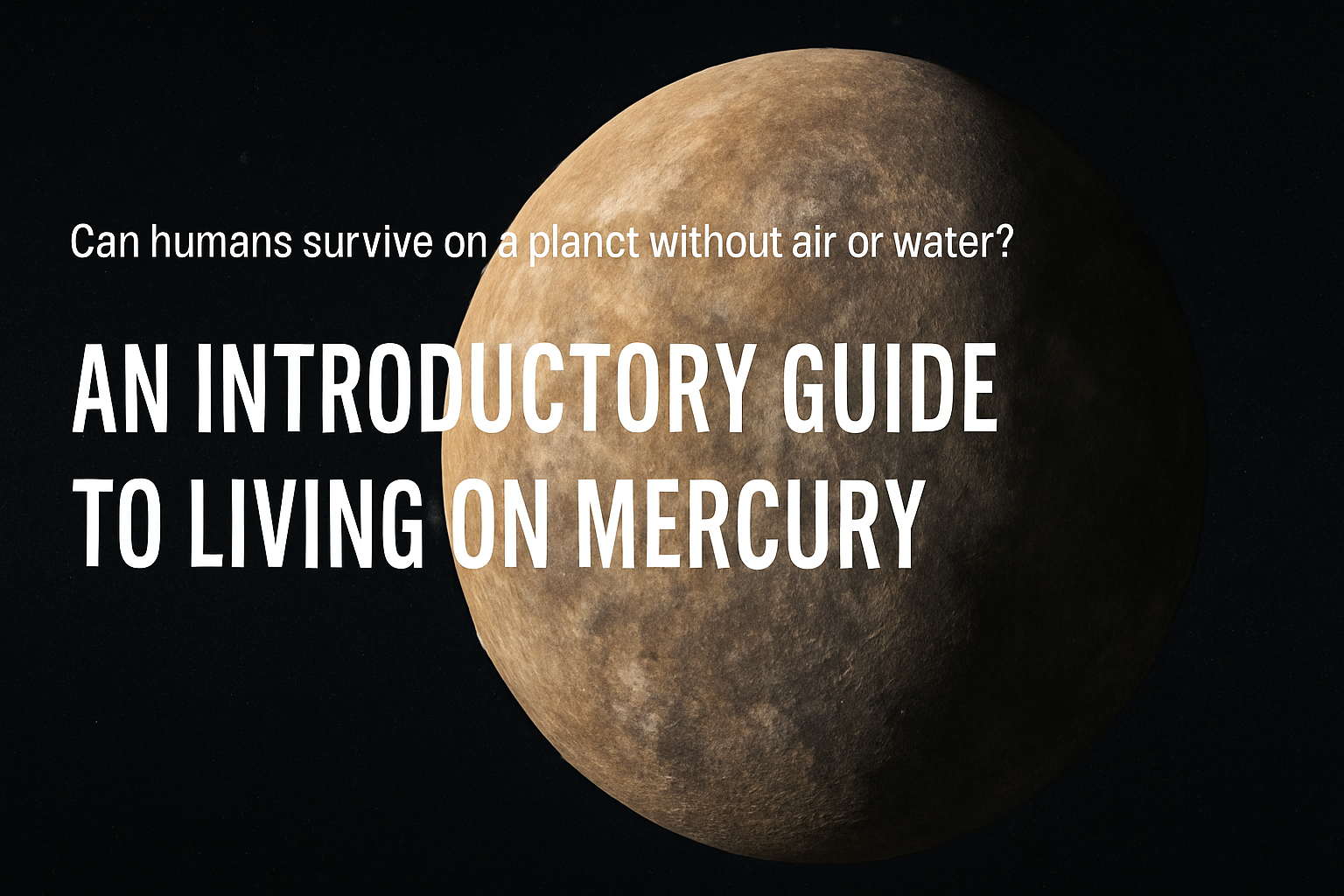
- Introduction|The Day Humans Live on Mercury May Be “Far in the Future,” but It’s Still a Dream Worth Imagining
- Chapter 1|So What Kind of Place Is Mercury?
- Chapter 2|How Could Humans Live There? Challenges and Practical Solutions
- Chapter 3|If You Lived on Mercury, What Would a Day Look Like?
- Chapter 4|How “Possible” Is Living on Mercury with Today’s Technology?
- Chapter 5|What We Can Do Today to Move Toward Future Mercury Habitation
- Conclusion|Mercury Habitation Is a “Distant Dream,” but the Path Toward It Is Real
Introduction|The Day Humans Live on Mercury May Be “Far in the Future,” but It’s Still a Dream Worth Imagining
“Living on Mercury” — it may sound like a scene straight out of a sci-fi movie. But as humanity turns its eyes to space and our technologies continue to advance, it’s worth asking: why should we even consider the idea of living on Mercury?
Mercury, the closest planet to the Sun, is so extreme that it hardly fits the image of a “place to live.” Yet thinking about how humans could survive in such an environment is filled with valuable insights for future space habitation and technological innovation. If long-term stays on the Moon or Mars become reality, discussions about living on even harsher planets might emerge one day.
In this article, we’ll explore what kind of place Mercury really is, how humans might manage to live there, what daily life could look like, and how close current technology is to making this dream possible — all explained in simple terms without heavy jargon.
Chapter 1|So What Kind of Place Is Mercury?
If we start from the premise of “living there,” understanding Mercury’s environment becomes essential. Here, we’ll look at what makes life on Mercury so incredibly challenging.
-
Extremely hot AND extremely cold due to its proximity to the Sun
Because Mercury is so close to the Sun, daytime temperatures are scorching. On the other hand, its night side plunges into freezing cold. This extreme temperature difference is one of the biggest hurdles to human habitation. -
Virtually no atmosphere — stepping outside would be instantly fatal
Mercury has almost no atmosphere. Without breathable air or temperature regulation, outdoor living like on Earth is impossible. -
Daytime: +430°C, Night: –180°C
Sunlit areas heat up to extreme temperatures, while shaded regions freeze. There’s no “comfortable middle zone” like on Earth. -
A surface covered with rugged craters
The ground is full of impact marks, requiring extensive leveling before any structures could be built. -
Gravity is about 38% of Earth’s
Not as low as the Moon, but still significantly different. This affects both human physiology and construction design.
Mercury is harsh — but precisely because of that, it’s a planet that sparks curiosity about how far human ingenuity could go.
Chapter 2|How Could Humans Live There? Challenges and Practical Solutions
To live on Mercury, we must overcome its hurdles one by one. Here we pair each major challenge with potential solutions.
-
Securing air and oxygen
With almost no atmosphere, sealed living modules would be essential. Systems like biomes using plants for oxygen circulation could resemble Earth’s biodomes. -
Managing extreme temperature differences
Beyond high-insulation buildings, living underground or inside craters could work. Giant sunshades, reflective materials, and artificial lighting to regulate day-night cycles are also possible solutions. -
Protection from intense radiation
Mercury’s proximity to the Sun means strong radiation. Habitats would need excellent shielding — living underground or using local rock as natural protection are promising options. -
Surface leveling and construction issues
The rugged terrain requires automated robots for land leveling. Using regolith (dust and rock) for 3D-printed structures could be a key technology. -
Transportation and energy
Mercury receives abundant sunlight, making solar power a major advantage. Radiation-resistant panels are necessary, but energy supply itself would be ideal. Cargo transport would rely on unmanned supply ships.
Chapter 3|If You Lived on Mercury, What Would a Day Look Like?
Imagining the scenario makes the idea feel a bit exciting. Here’s an example of what an ideal day might look like.
-
Morning: Wake up in a climate-controlled dome with gradually brightening lights
-
Late morning: Suit up for outside work — panel cleaning, equipment checks, surface inspection
-
Midday: Outdoor activities are minimized; most time is spent indoors conducting research or communicating with Earth
-
Evening: As temperatures stabilize, outdoor work becomes possible again
-
Night: Rest inside a well-shielded dome; perhaps unwind with VR landscapes of Earth
Life would occur entirely within controlled environments — a very different style of living compared to Earth.
Chapter 4|How “Possible” Is Living on Mercury with Today’s Technology?
The idea of living on Mercury is still extremely distant, but the related technologies are steadily advancing.
-
We’re gaining more observational data about Mercury, improving our understanding of its surface
-
Research on Moon and Mars habitats, radiation shielding, and construction tech can all be adapted to Mercury
-
Earth-based research in extreme environments (deep sea, Antarctica, underground) also provides valuable insights
Realistically, the progression would likely be: Moon → Mars → Mercury. Still, we are at a stage where “the path forward is beginning to appear.”
Chapter 5|What We Can Do Today to Move Toward Future Mercury Habitation
Even if we’re not heading to Mercury anytime soon, simply taking interest in future space habitation is a meaningful first step.
-
Learn about space and extreme environments
-
Study Earth’s polar research and underground architecture to understand survival in harsh conditions
-
Follow scientific news to stay updated on space development
-
Imagine “future ways of living” and consider space as an extension of everyday life
This mindset is the first step toward making space feel more accessible.
Conclusion|Mercury Habitation Is a “Distant Dream,” but the Path Toward It Is Real
Living on Mercury remains far beyond today’s technological capabilities. However, by examining “why we can’t live there yet,” we naturally uncover insights into “how we might eventually make it possible.”
The extreme environment demands complete control — but that challenge also fuels innovation and flexible thinking.
And above all, simply imagining “What if we could live on Mercury?” sparks fresh perspectives and curiosity about the future. What kind of life would *you* want to live on Mercury?


Comment