- Introduction|Are We Getting Close to Living on the Moon?
- Chapter 1|What Kind of Place Is the Moon?
- Chapter 2|What Would It Take to Live There? Problems and Solutions
- Chapter 3|What Would a Day on the Moon Look Like?
- Chapter 4|Projects Already in Motion
- Chapter 5|What Can We Do Now for a Future Lunar Life?
- Summary|Moon Migration Is No Longer a Dream, but a Plan Taking Shape
Introduction|Are We Getting Close to Living on the Moon?
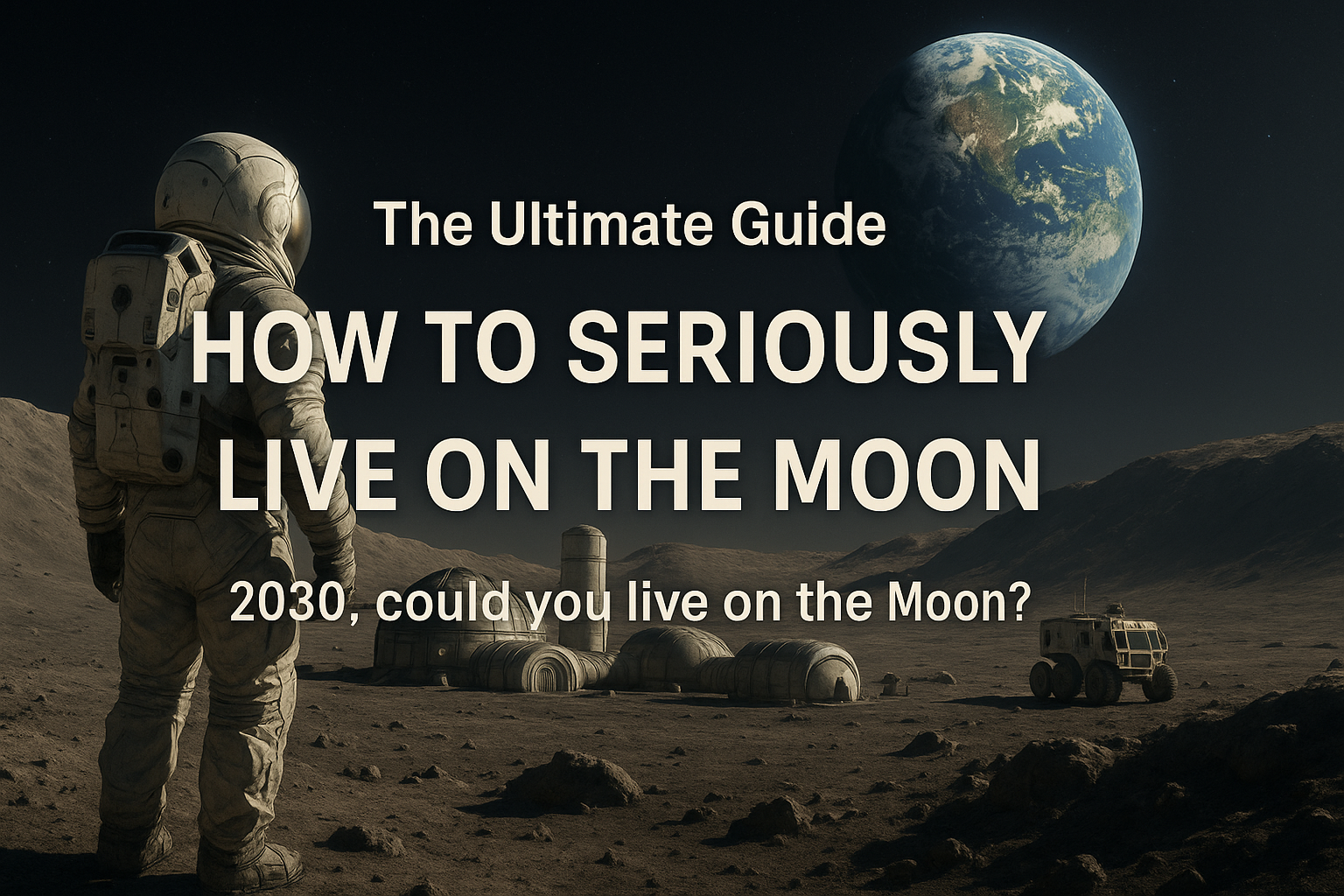
“Living on the moon” may sound like a dream, but did you know that it’s actually starting to become realistic?
Major organizations such as NASA (the U.S. National Aeronautics and Space Administration) and SpaceX (the space development company led by Elon Musk) are already seriously working on “lunar base concepts.”
This isn’t just a futuristic idea from a sci-fi movie. In 2025, NASA’s Artemis program is scheduled to send humans back to the lunar surface, and some experts believe that a new era of long-term human stays on the moon could follow.
Some specialists predict that between 2030 and 2040, the first people to “live on the moon” may actually emerge.
However, the moon is a completely different environment from Earth. Is there air? What about food? How do we move around? Communication? In this article, we will answer these questions one by one and guide you through the theme of “How can humans live on the moon?” in a simple and concrete way for beginners.
Chapter 1|What Kind of Place Is the Moon?
The moon is a celestial body called a “satellite,” orbiting close to Earth. But its environment is nothing like Earth’s.
First, let’s review the basic challenges of living on the moon and why it would be so difficult.
-
Gravity is 1/6 of Earth’s
The moon’s gravity is only one-sixth of Earth’s, meaning your body feels extremely light. A 60 kg person would feel like they weigh only about 10 kg. While this sounds fun, reduced strain on muscles and bones can weaken the body over time, making health maintenance a challenge. -
Almost no atmosphere
There is no atmosphere on the moon — no oxygen, no carbon dioxide. Humans cannot breathe there, so living requires a space suit or a completely sealed habitat. -
Daytime is 120°C, nighttime is -170°C
With no atmosphere, the moon’s temperature swings drastically — extremely hot during the day and extremely cold at night. These severe fluctuations pose major challenges for lunar living. -
Direct exposure to radiation
Earth’s magnetic field and atmosphere protect us from dangerous space radiation. The moon lacks both, meaning humans would be exposed to radiation directly. -
The surface is rocky and sandy
The moon’s surface is filled with craters and fine dust called “regolith,” creating a very uneven terrain. Walking or moving around isn’t easy.
Chapter 2|What Would It Take to Live There? Problems and Solutions
Despite being such a harsh environment, why is the idea of living on the moon now being taken seriously?
It’s because advances in technology have finally made “solutions” more realistic.
Let’s take a look at each challenge.
・No air → How do we create oxygen?
Humans need oxygen to survive, but the moon has none.
Recent studies show that lunar soil (regolith) contains oxygen-bearing minerals. Researchers are exploring methods to extract oxygen from regolith using special machinery.
Closed ecological systems — sealed habitats where plants produce oxygen — are also being tested. This could allow humans and plants to coexist and continuously produce breathable air.
・No water → Use lunar ice
The moon has no rivers or lakes, but recent exploration has confirmed the presence of ice near the lunar poles.
This ice could be melted for drinking water. And if split with electricity, it could supply oxygen — making it a vital resource.
・How do we secure food?
Producing food on the moon is one of the biggest challenges.
However, Earth already has advanced “plant factory” technology — controlled environments where crops are grown under LED lights through hydroponics, meaning plants can grow without sunlight.
If applied to the moon, basic food supplies could be produced locally, with additional supplies transported from Earth if needed.
・Where will people live?
Due to the dangers on the lunar surface, ideas such as “living underground” or “living inside dome-shaped shelters” are being considered.
Projects are also underway to build structures using 3D printers and lunar soil, reducing the need for transporting materials from Earth.
To guard against extreme temperatures and radiation, these shelters would need thick walls and special protective glass.
・How will communication and transportation work?
Communication between the Earth and the moon has up to a 2.7-second delay, which can interfere with real-time interactions.
To solve this, plans are underway to place dedicated communication satellites around the moon.
As for transportation, concepts include lunar rovers, hover bikes, and delivery drones. Toyota and JAXA are even developing a manned lunar vehicle.
Chapter 3|What Would a Day on the Moon Look Like?
If you were to live on the moon — what would your daily life be like?
Just imagining it is exciting.
-
Morning: Wake up as the air circulation system activates. Have breakfast inside a habitation dome where you don’t need a space suit.
-
Daytime: Travel by lunar rover to a research site. Conduct geological surveys and check solar power systems.
-
Evening: Harvest lettuce grown in the plant factory. Enjoy a homemade meal or packaged space food.
-
Night: Relax with books or movies while viewing Earth’s landscapes through VR.
-
Before bed: Check radiation levels and oxygen concentration. Sleep after confirming safety.
Such a lifestyle may actually become possible in the next 10 to 20 years.
Chapter 4|Projects Already in Motion
The idea of living on the moon is no longer just imagination. Several groups are already taking concrete action.
-
NASA’s Artemis program aims to send humans back to the lunar surface in 2025 and develop a long-term lunar base.
-
SpaceX plans to transport people and materials to the moon using its massive Starship rocket.
-
Toyota and JAXA are jointly developing the “Lunar Cruiser,” a pressurized lunar rover.
-
China and India are also advancing their own lunar exploration programs, showing global interest in the moon.
Chapter 5|What Can We Do Now for a Future Lunar Life?
It may still be difficult to go to the moon right now.
But technology is advancing rapidly. AI, robotics, renewable energy, food production, communications — as these technologies combine, the dream of living on the moon comes closer to reality.
Imagining “how you want to live on the moon” could expand your future possibilities.
Summary|Moon Migration Is No Longer a Dream, but a Plan Taking Shape
Thank you for reading.
What was once considered a “fantasy” — migrating to the moon — is now becoming a realistic possibility through concrete plans and advancing technologies.
Of course, many challenges remain, but humanity is steadily working toward solutions. One day, living on the moon may become as normal as “moving abroad” today.
And who knows — you, the reader of this article, might become one of the pioneers shaping that future.
So, would you like to live on the moon?

Comment