- Introduction|The day humanity lives on Venus may be far away, but it is still well worth thinking about
- Chapter 1|What kind of place is Venus in the first place?
- Chapter 2|How could we live there? A clear look at the challenges and solutions
- Chapter 3|If we lived on Venus, what would a typical day look like?
- Chapter 4|How likely is it that we could actually live there right now?
- Chapter 5|From now on, what can we imagine about humanity’s future on Venus?
- Conclusion|Living on Venus isn’t happening “right now,” but the path forward is slowly coming into view
Introduction|The day humanity lives on Venus may be far away, but it is still well worth thinking about
“Living on Venus” — when you hear these words, many people probably think, “That’s a total pipe dream,” or “Isn’t that physically impossible?” In fact, Venus is a planet with an extremely harsh environment, and it is certainly not somewhere we could migrate to anytime soon.
Yet precisely because of that, there is great value in整理ing questions like “Why would we even consider living on Venus?” and “What kind of technology would we need to make it possible?”
Venus is an intriguing world often called Earth’s “twin planet” because it has almost the same size and mass as Earth, even though its surface atmosphere, temperature, and pressure are completely different. It is studied as “the next frontier after Earth” and as a potential model for “living in extreme environments,” offering many insights when we think about our future.
In this article, we will walk through Venus’s environment, challenges, technologies, and possible lifestyles in a way that is easy for beginners to understand. So, shall we take a moment to imagine the future together?
Chapter 1|What kind of place is Venus in the first place?
If we are going to entertain the idea of “living” there, we first need to understand the basic characteristics of Venus.
● Similar to Earth, but the environment is completely different
Venus is similar to Earth in both mass and size, and its gravity is estimated to be about 90–95% that of Earth. In that sense, it is a planet where, at least in terms of “weight,” living would not be too unreasonable for humans.
However, its atmospheric composition, pressure, and temperature are like a completely different world. The surface environment is far too extreme for us to live on as we do on Earth.
● An extraordinarily thick atmosphere and “deep-sea level” pressure
The atmospheric pressure at the surface of Venus is about 90–93 times that of Earth. This corresponds to the pressure you would experience at a depth of about 900 meters under the ocean on Earth, a level that is difficult for humans — and even for most machines — to withstand.
● Surface temperatures above 460°C
Temperatures are high enough to melt lead. Normal metals and electronic devices would quickly fail in such conditions.
● A harsh sky filled with sulfuric acid clouds
The clouds of Venus contain droplets of sulfuric acid, making the atmosphere highly corrosive and toxic. It is not an environment where you can casually step outside.
In short, “living on the surface of Venus” is virtually impossible with today’s technology.
Chapter 2|How could we live there? A clear look at the challenges and solutions
So what kind of approach would allow humans to survive on Venus? Interestingly, researchers are exploring an idea that involves not living on the surface, but living high up in the atmosphere.
● 1) Using the “comfortable upper atmosphere” instead of the surface
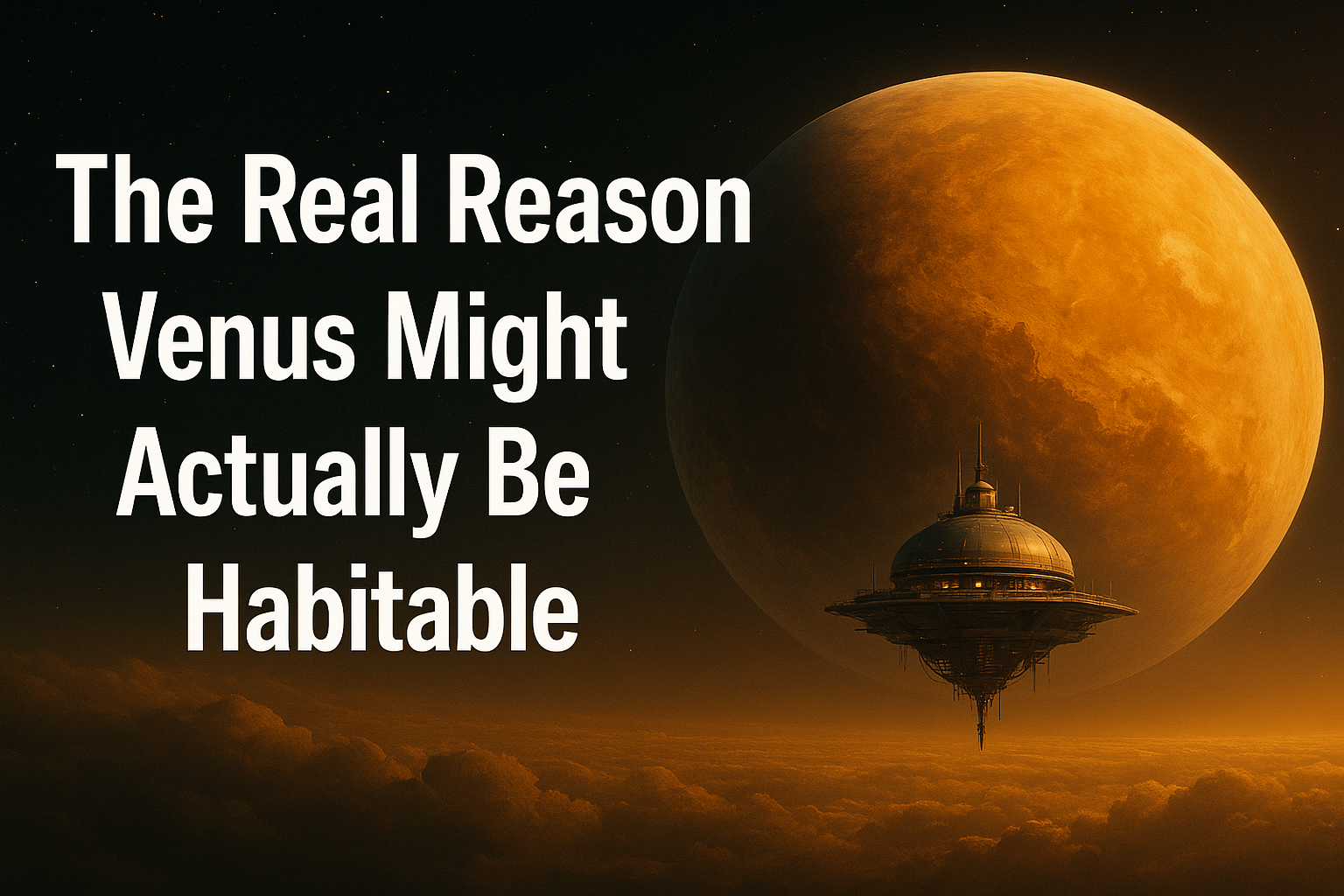
The surface is a triple threat of high temperature, high pressure, and corrosive conditions. However, at an altitude of about 50–60 km, the environment becomes comparatively mild:
・Pressure is similar to Earth’s
・Temperature is around 0–50°C
For this reason, concepts such as “floating domes (cloud city concepts)” and “giant balloon-type habitat cities” have been proposed as ways to live in the upper atmosphere.
● 2) Securing breathable air
Venus’s atmosphere is composed mostly of carbon dioxide. For humans to live there, we would need completely sealed habitats where air can circulate. Closed ecological systems that combine plants and artificial photosynthesis are also being studied.
● 3) Blocking and controlling heat and light
To cope with intense sunlight and thermal radiation, we would need:
・High-performance insulation materials
・Sunshades that reflect light
・Double-shell structures, and more
By adjusting the floating altitude, we could also choose temperature zones that are easier to live in.
● 4) Exploiting the advantage of solar energy
Because Venus is closer to the Sun, it is very suitable for solar power. Concepts often assume enormous panels that efficiently convert the intense sunlight into energy.
● 5) Structures that float in the upper atmosphere
The basic idea is to generate buoyancy using lightweight materials and air inside the structures. Developing materials that can withstand sulfuric acid clouds is also essential.
Only when multiple technologies like these come together does “living in the upper atmosphere” start to become a realistic option.
Chapter 3|If we lived on Venus, what would a typical day look like?
If it did become possible to live on Venus, what kind of daily life might we have?
Morning:
You wake up to sunlight rising above the thick cloud tops, seen through the window of a floating dome. At around 50 km altitude, the environment is similar to Earth’s, and inside the habitat the temperature is kept comfortable.
Late morning:
You carry out tasks unique to space living — cleaning exterior walls affected by sulfuric acid clouds, inspecting solar panels, and transmitting data back to Earth.
Noon:
You harvest vegetables grown in a hydroponic section of the habitat and use them for lunch. Outside the window stretches an endless sea of clouds.
Evening:
You inspect floating systems and airships and adjust the habitat’s altitude as needed. At sunset, you can see the sun sink slowly below the cloud tops in a breathtaking display of light.
Night:
You spend time gazing at the star-filled sky and the darkness of space beyond the sulfuric acid clouds. VR recreations of Earth’s scenery help ease homesickness.
Before bed:
Automatic monitoring systems check pressure, oxygen levels, temperature, and cloud composition to make sure everything is safe, then you turn in for the night.
Even imagining it is enough to conjure up a completely new kind of “life above the clouds.”
Chapter 4|How likely is it that we could actually live there right now?
The realization of a Venus habitat is still far in the future. However, that does not mean the possibility is completely zero.
● Research is underway on “cloud city” concepts that float in the upper atmosphere
● Closed-habitat technologies developed for the Moon and Mars could be adapted
● The upper atmosphere of Venus has conditions surprisingly similar to Earth’s, making it promising for habitation
● At the same time, living on the surface remains virtually impossible for now
Because of the enormous costs, technological hurdles, and logistical challenges involved, it is more realistic to think of Venus habitation as a “long-term future concept” rather than something we could achieve in the near future.
Chapter 5|From now on, what can we imagine about humanity’s future on Venus?
Technology is advancing slowly but steadily. The day we live on Venus may be far off, but simply thinking about it can already give us new perspectives.
● Venus is similar to Earth, yet its environment is completely different
● Considering how to overcome that harshness sparks new ideas
● Life high in the sky would be a completely new lifestyle
● It represents humanity’s challenge to nature, energy, and materials
Imagining a future where we live on Venus is a great way to think about how humanity might live and thrive out in space.
Conclusion|Living on Venus isn’t happening “right now,” but the path forward is slowly coming into view
The idea of “living on Venus” is certainly difficult to realize. But by整理ing each “reason we can’t live there” and thinking about how we might overcome them, we begin to see what future science and daily life might look like.
Venus is Earth’s twin and yet an entirely different world. A future where we live in its upper atmosphere may still be a distant dream, but imagining that future and looking forward to technological progress both carry great value.
— Would you like to try living on Venus?

Comment