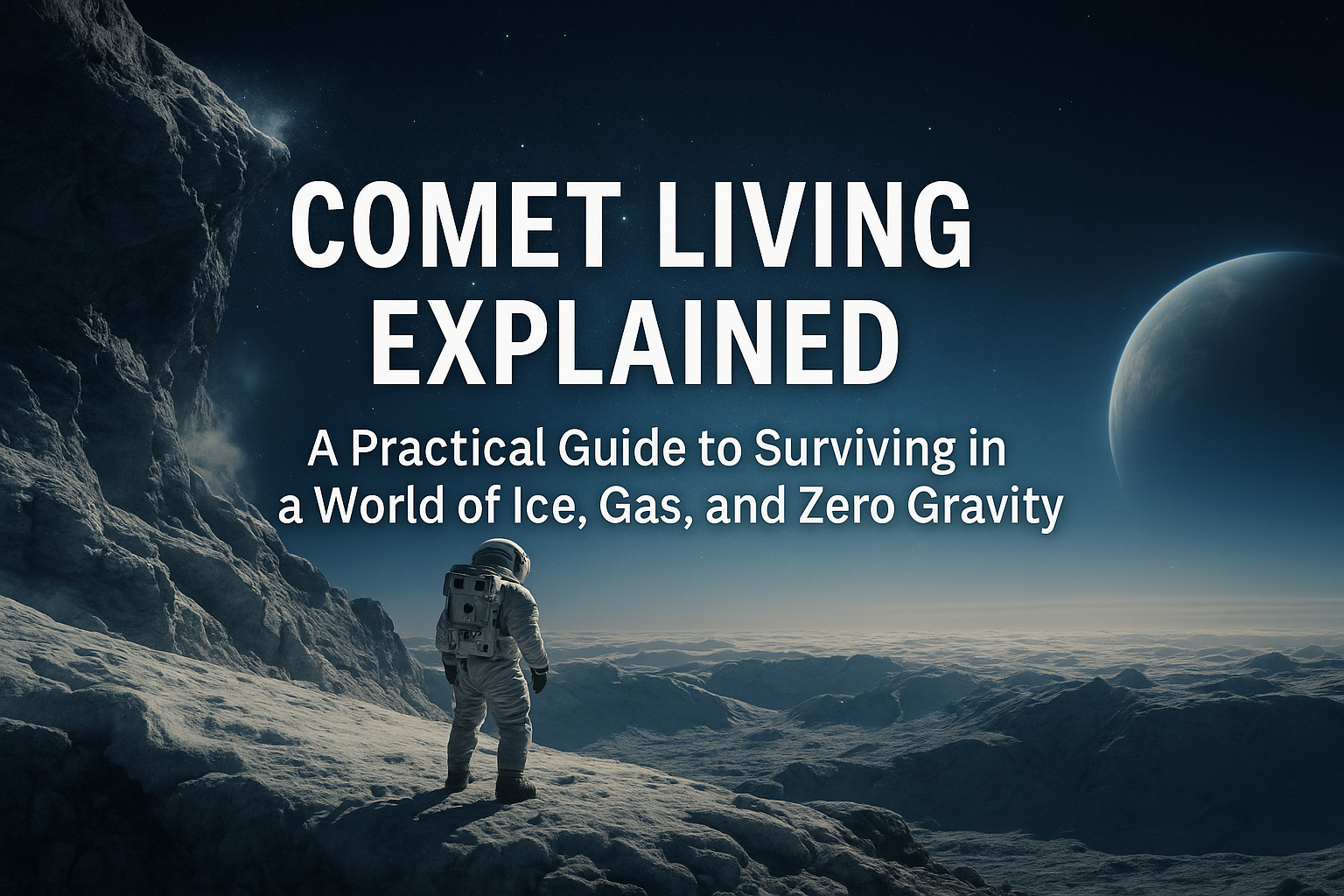

- 【Introduction | Will Humanity One Day Live on a Comet?】
- Chapter 1 | What Kind of Place Is a Comet, Anyway?
- Chapter 2 | How Could We Actually Live There?
- Chapter 3 | What Would a Typical Day Look Like on a Comet?
- ■ Morning: Waking up with gentle artificial gravity
- ■ Late Morning: Preparing to go outside the comet
- ■ Surface Work: Floating slightly above the ground
- ■ Midday: Relaxing in the “Half-Gravity Café”
- ■ Afternoon: Research and maintenance time
- ■ Evening: Enjoying the comet’s glowing tail
- ■ Night: Final safety checks and sleep
- Chapter 4 | Ongoing Real-World Projects That Are Bringing Comet Settlement Closer
- ■ JAXA’s Achievements: Insights from Small Body Missions
- ■ Private Companies Enter the Scene: The Rise of Space Resource Mining
- ■ Using a Comet as a “Mobile Space Base”
- ■ 1. Deepening Our Understanding of Science and Technology
- ■ 2. Practicing Sustainable Living on Earth
- ■ 3. Keeping Up With Space Exploration News
- ■ 4. Inspiring the Next Generation
- ■ 5. Recognizing That Space Will Become a New Economic Frontier
- ■ 6. Imagining the Future Is the First Step Toward Creating It
【Introduction | Will Humanity One Day Live on a Comet?】
“Living on a comet” — at first glance, the idea sounds like something straight out of a science-fiction novel. But you may be surprised to learn that this concept is slowly shifting from pure fantasy to a topic scientists are beginning to take seriously.
Comets are celestial bodies made of ice, dust, and rock, traveling on enormous orbits around the Sun. Although they look small and fragile compared to planets or moons, their interiors contain water ice, organic compounds, minerals, and other resources that could potentially support human life or fuel future space missions.
In recent years, major space organizations such as NASA, ESA (the European Space Agency), and JAXA (the Japan Aerospace Exploration Agency) have started to view comets as “resource-rich bodies” worth exploring. Some researchers have even begun to discuss the long-term possibility of using comets as outposts — places where humans might extract water, generate fuel, or even create protected living environments deep beneath their icy surfaces.
Of course, comets are nothing like Earth.
They have almost no gravity, no atmosphere, extreme temperatures, and they periodically release powerful jets of gas as they approach the Sun. These conditions make them far more dangerous than the Moon or Mars.
So the natural question is:
“How could humans possibly live on something as unstable as a comet?”
In this guide, we will walk through that question step by step.
We’ll explain:
-
what comets are actually like,
-
what challenges humans would face,
-
which technologies could solve those problems,
-
what daily life on a comet might look like,
-
and which real-world missions are already paving the way.
We’ll explore all of this as clearly and concretely as possible, without relying on difficult scientific terms — so even beginners can enjoy imagining this bold future.
Picture it for a moment:
A home carved inside an icy comet, drifting silently through the vastness of space… and you, looking out into the shimmering tail of the comet from your living quarters.
Let’s dive into this fascinating world and consider what it would really take for humanity to live on a comet.
Chapter 1 | What Kind of Place Is a Comet, Anyway?
Before we talk about living on a comet, the first question is:
“What exactly is a comet like?”
A comet is a small celestial body that travels around the Sun in a long, stretched-out orbit. Although it moves silently through space, its internal structure and surface environment are completely unlike anything on Earth.
Most comets are made of:
-
ice
-
dust
-
rocky fragments
-
trace organic molecules
At first glance, they may look like mysterious icy rocks floating in space—but once we dig deeper, we find an environment that is far more complex and challenging than it appears.
Here, we’ll go over the basic features of comets, especially the aspects that matter when considering whether humans could ever live on one.
■ Gravity That Is Practically “Zero”
A comet’s gravity is extremely weak—often just one-thousandth to one-ten-thousandth of Earth’s gravity.
To put that into perspective:
If you tried to jump on a comet’s surface, you might drift upward for several meters, even tens of meters, before gently coming back down.
This ultra-low gravity causes major challenges:
-
You can’t walk normally
-
Objects don’t stay where you put them
-
People and equipment float away with even slight movements
-
Doing any physical task becomes difficult
Living in such an environment would require specialized equipment, controlled spaces, and new ways of moving and working.
■ A Surface Made of Ice, Dust, and Fragile Rock
A comet’s surface is not solid like Earth’s ground.
Instead, it resembles something like:
“A snowy slope covered with dust and scattered with fragile rocks.”
The terrain includes:
-
brittle water ice
-
fine dust particles
-
loose rock fragments
Because of this, the surface can collapse or crumble easily.
Even taking a few steps is risky without proper gear.
When a comet approaches the Sun, parts of the surface melt or vaporize, causing:
-
sudden collapses
-
pits or holes
-
unstable terrain
-
cracks that can expand rapidly
This makes the environment unpredictable and dangerous.
■ Extreme Temperatures With No Middle Ground
Comets experience some of the most dramatic temperature changes in the solar system.
-
Far from the Sun: −200°C (−328°F) or even colder
-
Closer to the Sun: ice vaporizes violently and gas jets shoot out
Because comets have almost no atmosphere, sunlight heats exposed surfaces instantly, while shadows become brutally cold.
There is no “comfortable zone.”
Only extremes.
■ The Iconic Tail: What Is It Really?
When we see comets from Earth, we often admire their long, glowing tails.
But the truth behind them is surprisingly intense.
A comet’s tail forms when:
-
The Sun heats its surface
-
The ice vaporizes
-
Gas and dust are blasted into space
-
Solar wind pushes the material into long, luminous streams
The tail is beautiful, but it also means:
-
the comet is losing material
-
the surface is erupting
-
gas jets could be strong enough to damage structures
In other words, the tail is a warning sign that the comet is “active.”
■ No Atmosphere, and Radiation Everywhere
Unlike Earth, a comet has:
-
no air
-
no oxygen
-
no protection from radiation
This means:
-
humans cannot breathe outside
-
astronauts must wear suits at all times
-
cosmic rays and solar radiation hit directly
-
equipment is constantly exposed to energetic particles
Any living area would need to be tightly sealed and heavily shielded.
Fortunately, comets are made mostly of ice and rock—their material can serve as natural shielding if used correctly.
Chapter 2 | How Could We Actually Live There?
A Simple Guide to the Challenges and Solutions of Comet Living**
At this point, you might be wondering:
“Comets are that dangerous… so why are people even talking about living on one?”
The answer is simple:
Because technological progress is allowing us to seriously consider solutions to the problems that once seemed impossible.
In this chapter, we break down each major challenge of living on a comet—and the realistic solutions scientists are exploring today.
We keep everything beginner-friendly and avoid difficult terminology whenever possible.
■ Challenge 1: Gravity Is Far Too Weak
→ Solution: Artificial gravity or rotating living structures
Comet gravity is so small that simply moving your arm can send your whole body drifting upward.
This leads to problems like:
-
weakening muscles
-
bone loss
-
difficulty walking or working
-
tools and objects floating away
So how do we create a space where people can live normally?
✔ Solution 1: Use rotation to generate artificial gravity
By slowly rotating a living module, the centrifugal force pushes people “toward the floor,” creating a sense of gravity.
This idea appears in many sci-fi movies, but it’s actually realistic—NASA and other agencies are already studying it.
✔ Solution 2: Build the living space inside the comet
Comets are mostly ice.
By carving out the interior and installing a rotating habitat inside, it becomes easier to:
-
stabilize artificial gravity
-
protect residents
-
minimize risk from surface changes
The comet itself becomes a protective shell.
■ Challenge 2: Comets Release Powerful Gas Jets
→ Solution: Choose a stable comet and build inside it
When comets get close to the Sun, their ice vaporizes, creating explosive gas jets that shoot into space.
These can:
-
destroy structures
-
shake loose equipment
-
create new cracks or holes
✔ Pick comets with weaker activity
Some comets:
-
barely release gas
-
have more stable surfaces
-
contain harder, more solid nuclei
These are better candidates for settlement.
✔ Live underground, not on the surface
A carved-out interior habitat benefits from:
-
natural shielding from jets
-
stable temperatures
-
reduced risk of fractures
The inside of a comet is much safer than the outside.
■ Challenge 3: Extreme Temperature Swings
→ Solution: Internal habitats + engineered climate control
Temperatures on comets can swing wildly—from ultra-low to hot enough to trigger vaporization.
But inside the comet:
-
thick ice layers act as insulation
-
temperature changes are much smaller
-
environmental control becomes easier
✔ A heating and cooling system keeps things stable
Using:
-
solar power
-
compact nuclear generators
-
heat recycling systems
We can maintain comfortable living conditions.
■ Challenge 4: No Air at All
→ Solution: Make oxygen from ice or dust
Comets contain enormous amounts of frozen water (H₂O).
Using electrolysis, we can split water into:
-
oxygen → for breathing
-
hydrogen → for fuel
✔ Dust on the surface also contains oxygen-bearing minerals
Machines can extract oxygen from these minerals as well.
✔ Closed ecological systems
By combining:
-
plants
-
algae
-
controlled lighting
-
CO₂ recycling systems
we can create a miniature ecosystem that continuously supplies fresh air.
This technology is already being tested on the International Space Station.
■ Challenge 5: How Do We Get Water?
→ Solution: Melt the comet’s ice
Comets are practically giant freezers full of natural water.
By melting and filtering the ice, we gain:
-
drinking water
-
oxygen
-
hydrogen fuel
-
agricultural water
Water is one of the biggest advantages of living on a comet.
■ Challenge 6: How Do We Produce Food?
→ Solution: Closed plant factories + low-gravity farming technology
You can’t grow vegetables outside on a comet.
The ground is too loose, and gravity is far too weak.
Instead, we use:
✔ Sealed indoor plant factories
These include:
-
LED lighting for photosynthesis
-
hydroponic systems
-
automated nutrient cycles
-
clamping mechanisms to keep plants from drifting away
This makes it possible to grow:
-
leafy greens
-
herbs
-
algae
-
yeast-based protein foods
It’s not luxurious, but it’s sufficient for survival.
■ Challenge 7: Where Do We Live?
→ Solution: Dig into the comet and build an underground habitat
Since the surface is unstable, the best approach is:
carving out large rooms inside the comet.
Advantages include:
-
improved safety
-
protection from radiation
-
steady temperatures
-
reduced risk from gas jets
The comet becomes a “natural cave” that can be transformed into a comfortable living environment.
■ Challenge 8: How Do We Move Around?
→ Solution: Thruster-assisted movement outside, magnetic or anchored movement inside
With near-zero gravity, walking is almost impossible.
✔ External movement: Use micro-thruster suits
These suits:
-
stabilize posture
-
allow slow, controlled drifting
-
attach to the surface using specialized boots
✔ Internal movement
Inside the comet, people can move using:
-
magnetic rails
-
handholds
-
anchored pathways
-
slowly rotating corridors
Movement becomes a mix of floating and guided locomotion.
Chapter 3 | What Would a Typical Day Look Like on a Comet?
If you were to live on a comet—what kind of day would you actually experience?
It’s exciting just to imagine it, isn’t it?
Since comets have no air, almost no gravity, and dangerous surface conditions, everyday life would take place inside specially designed living spaces.
But that doesn’t mean life would feel cramped or unpleasant.
With the right design, the interior of a comet could feel like a futuristic space colony—comfortable, safe, and surprisingly peaceful.
Let’s walk through a full day of life on a comet, from morning to night, so you can picture it more vividly.
■ Morning: Waking up with gentle artificial gravity
You wake up in a rotating habitat carved inside the comet’s icy interior.
The rotation generates artificial gravity—about 70% of Earth’s gravity—just enough to feel grounded while still noticeably lighter.
It’s a strangely pleasant sensation.
A large digital window on the wall displays your choice of scenery:
sunrise over the ocean, a forest in spring, a city skyline, or even live footage of the distant stars outside.
The air in your room is fresh, thanks to the plants and algae growing in the habitat’s greenhouse.
The oxygen levels are carefully controlled, and the humidity feels refreshing.
After getting out of bed, you walk through the softly lit corridor to the shared dining area.
Breakfast consists of foods grown in the closed ecological system:
-
leafy greens and herbs from the plant factory
-
algae-based protein dishes
-
rehydrated fruit mixes
-
warm nutrient-rich soup heated using recycled system heat
The menu looks futuristic, but surprisingly it tastes quite normal.
■ Late Morning: Preparing to go outside the comet
Today’s mission involves checking the comet’s surface and collecting ice samples.
To go outside, you head to the suit chamber.
Since the external environment includes:
-
no air
-
temperatures far below freezing
-
unpredictable terrain
-
extremely low gravity
-
potential gas jets
you must wear a specialized suit.
It’s not the bulky suits used on Earth-based missions—it’s closer to a light powered exosuit.
It includes:
-
micro-thrusters for movement
-
posture control jets on the arms
-
a heating and cooling system
-
boots with retractable “ice claws” for traction
-
a helmet with a 360-degree heads-up display
Once fully equipped, you step into the airlock.
The door closes slowly behind you, pressure equalizes, and then—silence.
The outer door opens.
Beyond it lies a vast field of ice and dust, shimmering under distant sunlight.
The tail of the comet glows faintly behind the horizon.
You take your first step outside.
■ Surface Work: Floating slightly above the ground
The comet’s surface feels like a mix between frozen snow and dusty sand.
You push your foot down gently—too hard, and you’ll float upward.
Movement here is not “walking.”
It’s a graceful, slow-motion glide.
Your heads-up display tracks:
-
local temperature
-
your position
-
the comet’s rotation
-
nearby gas jet activity
-
safe paths across the surface
Your tasks might include:
✔ Collecting ice samples
A small drill extracts ice from below the surface. These samples help determine water purity and chemical composition.
✔ Monitoring gas jet activity
Tiny cracks or warm patches could signal upcoming eruptions.
✔ Checking solar panels
Although sunlight is weak this far from the Sun, high-efficiency panels still produce valuable power.
During your work, the stars shine brilliantly in the black sky.
The silence is overwhelming—peaceful, yet awe-inspiring.
■ Midday: Relaxing in the “Half-Gravity Café”
Once the surface work is done, you return through the airlock and remove your suit.
Lunch is served in the “Half-Gravity Café,” a recreation area where gravity is intentionally lowered.
The result?
-
standing feels effortless
-
drinks float slowly when poured
-
you can push off the floor gently and hover
It’s a playful, relaxing space designed to relieve stress.
Lunch may include:
-
a hydroponic lettuce sandwich
-
gel-form nutrient meals
-
freshly filtered water from melted comet ice
-
yeast-based baked snacks
It’s not gourmet cuisine, but it’s surprisingly satisfying.
■ Afternoon: Research and maintenance time
Afternoons are devoted to your assigned tasks.
These might include:
✔ Scientific research
Studying ice layers to understand how the comet formed and what materials it contains.
✔ Greenhouse care
Adjusting nutrient levels, checking plant growth, and maintaining the lighting cycle.
✔ Water and oxygen production
Processing ice into:
-
drinkable water
-
breathable oxygen
-
hydrogen fuel
✔ Habitat maintenance
Ensuring:
-
air circulation systems
-
temperature controls
-
radiation shields
-
structural stability
are all functioning properly.
Every task supports the survival of the entire habitat.
■ Evening: Enjoying the comet’s glowing tail
When work slows down, you spend the evening in leisure areas.
A large viewing screen displays real-time footage of the comet’s tail—streams of glowing gas and dust stretching into space.
It’s a breathtaking sight.
In your free time, you might:
-
watch Earth scenery in VR
-
listen to space radio broadcasts
-
exercise in the low-gravity gym
-
chat with other residents
-
read or relax in your private room
The quiet of the comet creates a unique sense of calm that you cannot experience on Earth.
■ Night: Final safety checks and sleep
Before going to bed, the entire habitat performs automatic safety checks:
-
oxygen balance
-
radiation levels
-
water reserves
-
structural integrity
-
activity of nearby gas jets
Once everything is confirmed safe, you return to your room.
The artificial gravity softens slightly at night, giving you a gentle floating sensation as you lie down.
It feels like drifting on a quiet sea of stars.
Soon, sleep takes over.
And another day on the comet comes to an end.
Chapter 4 | Ongoing Real-World Projects That Are Bringing Comet Settlement Closer
By now, you may be thinking:
“Is comet living really something humanity could achieve?”
It’s a natural question.
But the truth is that comet-related research is already far more advanced than most people realize.
Humanity has:
-
landed spacecraft on comets
-
analyzed comet material
-
observed their internal structure
-
tested low-gravity landing technologies
-
explored how to extract resources from small bodies
These accomplishments are not theories—they have already happened.
And each achievement becomes another stepping stone toward future comet settlements.
In this chapter, we’ll explore several major missions and research projects that directly contribute to the possibility of living on a comet.
■ ESA’s “Rosetta Mission”: A Landmark in Comet Exploration
No discussion about comet exploration is complete without mentioning Rosetta, a historic mission by the European Space Agency (ESA).
Rosetta changed our understanding of comets forever.
✔ A 10-year journey to reach a comet
Rosetta traveled through space for over a decade before finally rendezvousing with Comet 67P/Churyumov–Gerasimenko.
It became the first spacecraft in history to orbit a comet.
✔ The lander “Philae” touched down on the surface
The most groundbreaking moment was the deployment of the lander Philae, which made the first-ever soft landing on a comet.
Although Philae bounced and struggled to anchor itself, it successfully collected invaluable data, such as:
-
the hardness of the comet’s surface
-
chemical composition of dust and ice
-
hints of organic molecules
-
internal structure information
-
behavior of gas activity
These discoveries revealed that comets contain water ice and organic compounds, reinforcing the idea that comets may have delivered the building blocks of life to early Earth.
They also provided scientific justification for the idea that comets could one day serve as:
-
water sources
-
fuel stations
-
potential shelters
-
scientific outposts
In other words, Rosetta didn’t just explore a comet—it expanded the possibilities for human settlement.
■ NASA’s Research: Viewing Comets as “Resource Stations”
NASA has begun to treat comets as potential resource hubs for deep-space missions.
Inside a comet’s nucleus, scientists have identified:
-
abundant water ice
-
hydrogen and oxygen sources
-
organic material
-
dust with oxygen-bearing minerals
-
volatile substances usable as fuel
NASA’s research focuses on:
✔ Extracting oxygen and hydrogen from comet ice
Electrolysis could supply both breathable air and rocket propellant.
✔ Using comets as fuel depots
Imagine spacecraft refueling in space, rather than carrying all their fuel from Earth.
✔ Creating bases inside comet interiors
The ice and rock layers could act as natural protection against radiation.
✔ Using comet orbits as transportation routes
Since comets travel throughout the solar system, they could become moving “hubs” for exploration.
These ideas push comet living from “science fiction” toward strategic planning for future deep-space missions.
■ JAXA’s Achievements: Insights from Small Body Missions
Japan’s space agency JAXA has not yet visited a comet, but its asteroid missions—Hayabusa and Hayabusa2—have provided essential knowledge for future comet settlements.
These missions succeeded in:
-
landing on extremely low-gravity surfaces
-
collecting samples
-
observing dust and rock behavior
-
drilling and sampling unstable terrain
-
returning material to Earth
Especially the samples from asteroid Ryugu revealed:
-
hydrated minerals (containing water)
-
organic molecules
-
signs of ancient chemical processes
This supports the theory that water and the ingredients for life may be common on small celestial bodies, including comets.
For comet living, the key lessons include:
-
how to land safely in microgravity
-
how to collect and analyze ice or dust
-
how to anchor equipment
-
how fragile surface material behaves
-
how to drill inside unstable bodies
These technologies are essential for building habitats inside comets.
■ Private Companies Enter the Scene: The Rise of Space Resource Mining
In recent years, several private companies have begun targeting small bodies—including comets—for resource extraction.
Examples include:
-
Deep Space Industries
-
Planetary Resources
-
European space mining startups
-
Israeli exploration ventures
They aim to extract:
-
water ice
-
valuable metals
-
volatile elements
-
materials for space-based manufacturing
This marks a major shift:
space is no longer only a government-led domain.
The private sector is accelerating technological development that will make comet habitation more viable.
■ Using a Comet as a “Mobile Space Base”
Some researchers propose using comets as:
-
slowly traveling space habitats
-
moving fuel depots
-
natural radiation shelters
-
transport hubs that follow their solar orbits
Because comets already move through vast regions of the solar system, they could become:
✔ mobile space stations
✔ self-sustaining resource platforms
✔ protected research outposts
If humans could establish a habitat inside a comet, the comet itself becomes a giant, naturally shielded spacecraft.
This concept is one of the boldest—and most intriguing—proposals in modern space science.
Chapter 5 | What We Can Do Today to Prepare for a Future of Living on Comets
After everything we’ve explored so far, you may now see that living on a comet is not just wild speculation.
It’s a vision beginning to take shape—supported by real missions, real technologies, and real discoveries.
Comets contain:
-
water
-
oxygen sources
-
hydrogen for fuel
-
natural shielding materials
-
stable inner environments
In many ways, they offer the essential ingredients for sustaining human life in deep space.
Still, large challenges remain.
So what can we—ordinary people—do today as we move toward this future?
Here are several meaningful steps that connect our present lives to humanity’s cosmic future.
■ 1. Deepening Our Understanding of Science and Technology
When people hear “space settlement,” they often imagine rocket science or advanced physics.
But the truth is, the technologies needed to live on a comet overlap deeply with everyday fields such as:
-
renewable energy
-
AI and automation
-
battery and power systems
-
water purification
-
indoor agriculture
-
robotics
-
material engineering
By learning about these topics—even casually—we broaden our awareness of the technologies that will shape the future.
You don’t need a degree in astrophysics.
Simply staying curious, reading, or watching educational content already strengthens the foundation for future space literacy.
■ 2. Practicing Sustainable Living on Earth
Life on a comet would require a perfectly closed loop:
-
water must be recycled
-
food must be produced efficiently
-
air must be regenerated
-
waste must be minimized
Interestingly, these are the same challenges we face on Earth.
Our daily habits—saving energy, reducing waste, recycling, supporting local food production—are not just environmental acts.
They mirror the exact systems that make comet living possible.
In a sense:
Earth is the training ground for living sustainably in space.
■ 3. Keeping Up With Space Exploration News
Space development is advancing at a breathtaking pace.
Reading about:
-
new NASA missions
-
ESA and JAXA discoveries
-
private space companies
-
asteroid and comet research
-
new propulsion systems
-
breakthroughs in habitats and life-support
helps us follow the direction humanity is heading.
Understanding these trends gives us insight into which technologies and careers may lead directly to the future of comet settlements.
■ 4. Inspiring the Next Generation
Comet habitation is not just a scientific challenge—it’s a spark for imagination.
Children who learn about space today may grow up to be:
-
space engineers
-
exobiologists
-
habitat designers
-
robotic miners
-
comet farmers
-
deep-space navigators
By exposing young people to scientific curiosity, we open doors to careers that may not even exist yet.
A child who dreams of living on a comet today might be the scientist who builds the first comet home tomorrow.
■ 5. Recognizing That Space Will Become a New Economic Frontier
Space is rapidly becoming a major industry.
We are already seeing:
-
commercial satellite networks
-
space resource mining startups
-
space tourism
-
private lunar missions
-
autonomous robotic exploration
-
closed-loop life-support companies
Comet settlement will require:
-
fuel production
-
water extraction
-
habitat construction
-
agricultural systems
-
environmental monitoring
-
radiation protection
-
AI-supported operations
This means completely new industries—and therefore new opportunities—will emerge.
The future of space is not only for astronauts.
It will involve programmers, designers, educators, farmers, doctors, artists, and many more.
■ 6. Imagining the Future Is the First Step Toward Creating It
Every major human achievement began as someone’s idea.
Before rockets existed, they were imagined.
Before electricity became widespread, it was a dream.
Before smartphones, they appeared in science fiction.
In the same way:
Imagining life on a comet is the first step toward making it possible.
Ask yourself:
-
What kind of home would you build inside a comet?
-
What foods would you grow?
-
What would your daily routine look like?
-
What jobs would exist in a comet settlement?
-
What would you see when you looked out the window?
Your imagination isn’t useless—it’s how progress begins.
【Conclusion | Comet Settlement Is No Longer a Distant Fantasy — It Is Becoming a Realistic Future Path】
Thank you so much for reading this far.
When you first hear the idea of “living on a comet,” it may sound like pure science fiction — something so unrealistic that it’s hard to take seriously.
After all:
-
a comet has no atmosphere,
-
gravity is almost nonexistent,
-
temperatures swing from extreme cold to intense heat,
-
and gas jets erupt without warning.
It’s natural to think,
“There’s no way humans could ever live there.”
But as we’ve explored in this guide, comets also offer remarkable advantages:
-
abundant water ice
-
materials for oxygen and fuel
-
natural shielding from radiation
-
stable interior environments
-
potential for building underground habitats
And most importantly, humanity has already taken major steps forward:
-
landing on comets
-
drilling into their surfaces
-
analyzing their materials
-
confirming the presence of water and organics
-
developing low-gravity technologies
-
advancing indoor agriculture and closed-loop life-support
Piece by piece, the technological foundations needed for comet settlement are being put into place.
Of course, challenges remain:
-
microgravity health hazards
-
unpredictable gas jets
-
long-term psychological stress
-
resource extraction efficiency
-
propulsion and transport issues
-
habitat safety
None of these will be solved overnight.
But with continuous scientific effort, each obstacle becomes a problem we can eventually overcome.
And when that happens — when the pieces finally come together — comets may transform into:
-
strategic waypoints for deep-space travel
-
fuel and water stations
-
protected research bases
-
new homes for future explorers
A time may come when saying
“I live inside a comet”
is no stranger than saying
“I live abroad.”
And who knows — perhaps you, or someone you love, or someone yet to be born, will be among the first to call a comet home.
The future of humanity will not be limited to one planet.
We are slowly, but surely, learning how to live among the stars.


Comment